RBT Study Guide 2026: Complete BACB 3rd Edition Exam Prep (Updated for the New Task List)
The RBT Study Guide is a structured preparation resource designed to help candidates pass the Registered Behavior Technician (RBT) certification exam, administered by the Behavior Analyst Certification Board (BACB) through Pearson VUE. As of January 1, 2026, the exam follows the BACB RBT Task List 3rd Edition (Test Content Outline) and covers 6 domains, 43 tasks, and 85 multiple-choice questions (75 scored + 10 unscored pilot) in a 90-minute in-person testing format. A complete RBT study guide includes the Task List breakdown, exam weightings, key ABA concepts, sample questions, a study plan, and ethics review. Candidates typically need 40–80 hours of focused preparation beyond the mandatory 40-hour RBT training to pass on the first attempt, with most successful candidates aiming for 80%+ on full-length mock exams before scheduling Pearson VUE.
Key Points of the RBT Study Guide (TL;DR)
- Certification body: Behavior Analyst Certification Board (BACB)
- Testing provider: Pearson VUE — in-person testing centers only (remote proctoring discontinued September 2023)
- Active version: RBT Test Content Outline 3rd Edition, effective January 1, 2026
- Exam format: 85 multiple-choice questions (75 scored + 10 unscored pilot), 90-minute time limit
- Passing score: Scaled scoring — aim for ~80% on practice exams before sitting the real test
- Total cost: $110 in BACB and Pearson VUE fees ($65 application + $45 exam appointment)
- Domains tested (6): Data Collection & Graphing, Behavior Assessment, Behavior Acquisition, Behavior Reduction, Documentation & Reporting, and Ethics
- Eligibility: Age 18+, high school diploma or equivalent, 40-hour training, Initial Competency Assessment, background check
- First-time pass rate: ~75%; retake pass rate drops to ~38% — preparation quality matters more than quantity
- Recommended prep time: 2–6 weeks of structured study with active recall, scenario-based practice, and full-length timed mocks
What Is the RBT Study Guide?
An RBT study guide is a structured learning resource that organizes the entire BACB RBT Task List into reviewable sections, paired with sample questions, definitions, examples, and practice quizzes designed to prepare candidates to pass the official Registered Behavior Technician certification exam on the first try.
A high-quality RBT study guide isn’t a textbook. It’s a focused roadmap that maps directly onto the six domains of the BACB Test Content Outline (3rd Edition), with content depth proportional to how heavily each domain is weighted on the actual exam. The best guides combine:
- Concept explanations in plain language (not academic jargon)
- Real clinical examples that mirror Pearson VUE scenario questions
- Practice questions with detailed answer rationales
- A study schedule organized by domain difficulty and weight
- Ethics, documentation, and supervision review aligned with the BACB Ethics Code for RBT Certificants
- Memory aids and quick-reference tables for confused terms (DRA vs. DRI, forward vs. backward chaining, etc.)
This guide covers all of the above fully updated for the 2026 BACB 3rd Edition Task List.
What Is the RBT Exam and Who Administers It?
The RBT exam is a 90-minute, 85-question multiple-choice certification test administered by Pearson VUE on behalf of the Behavior Analyst Certification Board (BACB). It assesses entry-level competency for behavior technicians who deliver Applied Behavior Analysis (ABA) services under the supervision of a BCBA or BCaBA.
The RBT credential is required by most ABA employers across the United States and is increasingly required internationally as ABA expands globally. Once certified, RBTs work in schools, in-home therapy programs, autism treatment centers, hospitals, and clinics — implementing behavior intervention plans designed by Board Certified Behavior Analysts.
The certification was created by the BACB in 2014 to standardize entry-level practice in ABA. The Task List has been revised three times since then, with the 3rd Edition (effective January 1, 2026) representing the largest update expanding from 37 to 43 tasks, doubling the ethics tasks from 5 to 10, and adding new requirements around cultural humility and data analysis.
RBT Exam at a Glance (Official 2026 Facts)
| Detail | Information |
|---|---|
| Certification body | Behavior Analyst Certification Board (BACB) |
| Testing provider | Pearson VUE (in-person only since Sept 2023) |
| Active framework | RBT Test Content Outline 3rd Edition (Jan 1, 2026) |
| Total questions | 85 (75 scored + 10 unscored pilot) |
| Time limit | 90 minutes |
| Question format | Multiple choice, 4 options, 1 correct answer |
| Total tasks | 43 across 6 domains |
| Passing score | Scaled (target ~80% on practice exams) |
| BACB application fee | $65 |
| Pearson VUE exam fee | $45 per attempt |
| Total minimum cost | $110 |
| Retakes allowed | Up to 8 within a 12-month window |
| Wait between retakes | Minimum 7 days |
| First-time pass rate | ~75% |
| Retake pass rate | ~38% |
| Credential validity | 1 year (annual renewal required) |
What Does the RBT Exam Cover? The 6 Domains of the 3rd Edition Task List
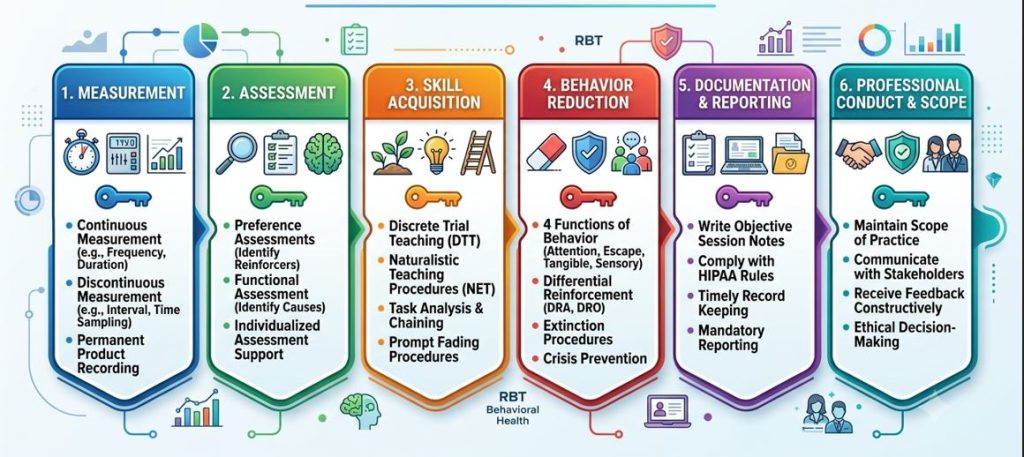
The RBT exam covers six domains based on the BACB Test Content Outline (3rd Edition): Data Collection & Graphing (17%), Behavior Assessment (11%), Behavior Acquisition (25%), Behavior Reduction (19%), Documentation & Reporting (13%), and Ethics (15%).
The 3rd Edition rebalanced the exam to put more weight on ethics and data literacy and slightly less on skill acquisition compared to the 2nd Edition. The breakdown below reflects the official BACB blueprint effective January 1, 2026.
Domain Weighting Table (3rd Edition, 2026)
| # | Domain | Exam Weight | Approx. Scored Questions |
|---|---|---|---|
| A | Data Collection & Graphing | 17% | ~13 questions |
| B | Behavior Assessment | 11% | ~8 questions |
| C | Behavior Acquisition | 25% | ~19 questions |
| D | Behavior Reduction | 19% | ~14 questions |
| E | Documentation & Reporting | 13% | ~10 questions |
| F | Ethics | 15% | ~11 questions |
| Total | 100% | 75 scored |
Domain A: Data Collection & Graphing (17%)
This domain tests your ability to collect, calculate, and interpret behavioral data accurately. The 3rd Edition added new tasks specifically around identifying trends in graphed data and summarizing data using different metrics (rate, mean duration, percentage).
Key concepts to master:
- Continuous measurement: frequency, rate, duration, latency, inter-response time (IRT)
- Discontinuous measurement: partial-interval recording, whole-interval recording, momentary time sampling
- Permanent product recording: measuring the result of behavior rather than the behavior itself
- Calculating and summarizing data: percentage correct, mean duration, rate per minute
- Updating graphs and identifying trend, level, and variability
- Operational definitions — observable and measurable terms
Common exam trap: Confusing partial-interval (records if behavior occurred at any point in the interval tends to overestimate) with whole-interval recording (records only if behavior occurred for the entire interval tends to underestimate).
Domain B: Behavior Assessment (11%)
This is the smallest domain by weight but heavy on understanding the RBT’s supporting role. RBTs assist BCBAs with assessments; they do not design, modify, or interpret them independently.
Key concepts:
- Preference assessments: Multiple Stimulus Without Replacement (MSWO), paired stimulus (forced choice), free-operant, single stimulus
- ABC data collection (Antecedent–Behavior–Consequence)
- Indirect vs. descriptive functional assessment procedures
- Participation in skill strength and deficit assessments
- Knowing when to escalate observations to your supervisor
Common exam trap: Believing RBTs can independently design or change an assessment. The correct answer is almost always “consult the supervising BCBA.”
Domain C: Behavior Acquisition (25%) — Largest Domain
This is the highest-weighted domain and deserves the most study time. The exam tests application, not just definitions.
Key concepts:
- Discrete Trial Training (DTT): antecedent (SD) → response → consequence → ITI
- Naturalistic Environment Teaching (NET): incidental teaching, mand training
- Prompting hierarchies: most-to-least, least-to-most, graduated guidance
- Prompt types: physical, gestural, verbal, modeling, visual, positional
- Prompt fading procedures
- Chaining: forward, backward, total task
- Shaping (reinforcing successive approximations)
- Stimulus control transfer and discrimination training
- Errorless learning
- Token economy systems
- Generalization across people, settings, and stimuli
- Verbal behavior operants: mand, tact, echoic, intraverbal
Common exam trap: Confusing forward chaining (first step taught independently, rest prompted) with backward chaining (last step taught independently, earlier steps prompted). Mnemonic: Forward = First independent; Backward = Bottom (end) independent.
Domain D: Behavior Reduction (19%)
Tests how RBTs implement Behavior Intervention Plans (BIPs) ethically and predict expected side effects.
Key concepts:
- Extinction and the extinction burst (temporary increase before decrease)
- Spontaneous recovery of an extinguished behavior
- Differential reinforcement:
- DRA — Differential Reinforcement of Alternative behavior
- DRI — Differential Reinforcement of Incompatible behavior (physically can’t co-occur with problem behavior)
- DRO — Differential Reinforcement of Other behavior (absence of target behavior)
- DRL — Differential Reinforcement of Lower rates
- Noncontingent reinforcement (NCR)
- Antecedent modification strategies
- Crisis and emergency safety procedures
Common exam trap: Failing to anticipate an extinction burst. If a question describes behavior increasing right after extinction begins, that’s normal and expected — not a sign the procedure is failing.
Quick reference: Differential Reinforcement:
| Procedure | Reinforce when… | Example |
|---|---|---|
| DRA | An alternative behavior occurs | Hand-raising instead of calling out |
| DRI | An incompatible behavior occurs | Hands in lap instead of hitting |
| DRO | Target behavior is absent for X time | No swearing for 5 minutes → reinforce |
| DRL | Behavior occurs at a lower rate | Asking fewer questions per session |
Domain E: Documentation & Reporting (13%)
Tests objectivity, accuracy, and the line between observation and interpretation.
Key concepts:
- Writing objective session notes (observable, measurable, no opinion)
- Distinguishing objective from subjective language
- Data integrity standards
- Reporting session variables that affect progress (illness, sleep, medication changes)
- Incident reporting procedures
- HIPAA and confidentiality
- Communication with the supervision team
Common exam trap: Including interpretations in notes. “The client was frustrated” is subjective. “The client threw materials and screamed for 12 seconds when asked to begin math” is objective.
Domain F: Ethics (15%)
The 3rd Edition doubled the number of ethics tasks from 5 to 10. Ethics is now nearly tied with Skill Acquisition for study priority on a per-question basis.
Key concepts:
- BACB Ethics Code for RBT Certificants (2.0)
- Scope of practice and competence
- Supervision requirements (minimum 5% of monthly hours)
- Confidentiality and HIPAA
- Gift-giving and receiving guidelines
- Dual relationships — identification and mitigation
- Cultural humility and responsiveness (new in 3rd Edition)
- Client dignity and rights
- Mandatory reporting obligations
- Public statements (including social media)
Common exam trap: Accepting a small gift “to avoid hurting the caregiver’s feelings.” The BACB code says decline regardless of intent.
How Many Questions Are on the RBT Exam?
The RBT exam has 85 multiple-choice questions: 75 scored questions and 10 unscored pilot questions used by the BACB to test new items for future exams. Candidates have 90 minutes to complete all 85.
You won’t know which questions are pilot items, so treat every question as if it counts. Each question presents four answer options, and only one is correct. There are no fill-in-the-blank, essay, or multi-select questions.
What Is the Passing Score for the RBT Exam?
The BACB uses a scaled scoring system administered by Pearson VUE and does not publish an exact cut score. In practice, candidates need to answer approximately 75% of the scored questions correctly roughly 60 out of 75 to pass.
The scaled scoring system means small variations in difficulty between exam forms are accounted for, so the raw number of correct answers needed may shift slightly from one administration to another. The safest benchmark: score 80%+ consistently on full-length practice exams before scheduling your Pearson VUE appointment.
How Much Does the RBT Exam Cost?
The total cost to sit for the RBT exam is $110 a $65 BACB application fee plus a $45 Pearson VUE exam appointment fee. Retakes cost an additional $45 each.
| Fee | Amount | Paid To |
|---|---|---|
| Certification application | $65 | BACB |
| Exam appointment | $45 | Pearson VUE |
| Retake (per attempt) | $45 | Pearson VUE |
| Recertification (annual) | $50 | BACB |
Additional optional costs to budget for:
- 40-hour RBT training course: $0–$400 (often covered by employer)
- Background check: $30–$80 (often covered by employer)
- Competency assessment: $50–$150 (often covered by employer)
- Study materials and practice tests: $0–$100 (excellent free resources exist)
- Travel to nearest Pearson VUE center if rural: variable
Total realistic out-of-pocket: $145–$665+ depending on whether your employer covers training.
Is the RBT Exam Hard?
The RBT exam is moderately difficult challenging enough that 25% of first-time candidates fail, but very passable with structured preparation. The main difficulty comes from scenario-based questions that require applying ABA principles rather than reciting definitions.
Three things make the exam harder than candidates expect:
- Scenario application, not memorization. Most questions describe a clinical situation and ask you to pick the best response. Memorizing definitions isn’t enough.
- Plausible distractors. In ethics and documentation, two answer choices often look correct. You have to pick the best answer per the BACB code.
- Time pressure. 90 minutes for 85 questions = about 63 seconds per question. Candidates who linger early run out of time at the end.
The exam is not designed to trick you, and it’s not pulled from obscure research. Every testable item maps to a specific task on the BACB Task List. If you know the Task List well and have practiced under timed conditions, the exam is achievable.
What Is the RBT Exam Pass Rate?
According to BACB-reported data, approximately 75% of first-time RBT candidates pass the exam. The retake pass rate drops sharply to around 38%, which underscores the importance of strong preparation before the first attempt.
The drop on retakes isn’t because the exam gets harder — it’s because most candidates who fail repeat the same passive study habits (re-reading notes, watching videos) without switching to active recall and scenario-based practice. Candidates who change their study method between attempts pass at much higher rates than those who simply restudy the same way.
How Long Should I Study for the RBT Exam?
Most candidates need 2 to 6 weeks of focused preparation beyond the mandatory 40-hour training. Those with prior ABA experience can pass with 2–3 weeks (20–30 study hours); those new to ABA generally need 4–6 weeks (40–80 study hours) of structured study.
The “right” length depends less on calendar time and more on how you study. A candidate doing 1 hour per day of active recall and practice questions for 3 weeks will outperform a candidate who reads the Task List PDF for 8 hours the night before.
Recommended weekly time investment:
- 5+ years ABA experience: 1–2 weeks, 10–15 hours total
- 6 months–2 years experience: 3–4 weeks, 25–40 hours total
- New to ABA, just finished 40-hour training: 4–6 weeks, 40–80 hours total
Can You Take the RBT Exam Online?
No. As of September 2023, the BACB discontinued the remote online proctored option for the RBT exam due to test security concerns. The exam is now delivered exclusively in person at authorized Pearson VUE testing centers.
When scheduling, search the Pearson VUE site for the nearest BACB-authorized test center. In some rural regions you may need to travel — factor that into your timing and budget.
What Happens If You Fail the RBT Exam?
If you fail the RBT exam, you can retake it after a minimum 7-day waiting period. The BACB allows up to 8 attempts within a 12-month window. Each retake costs $45 (Pearson VUE fee) no additional BACB application fee is required as long as your authorization is still valid.
After failing, you’ll receive a domain-level score report from Pearson VUE showing which of the 6 domains you scored lowest in. Use that breakdown to target your retake preparation rather than restudying everything equally.
Retake recovery plan:
- Wait at least 7 days (mandatory).
- Pull your score report and identify your 2 weakest domains.
- Switch from passive to active study — practice questions only on weak domains for the first week.
- Take a full 85-question timed mock exam. If you score 80%+, schedule the retake. If not, repeat targeted practice.
- On retake day, manage time more carefully — many failures are time-pressure related.
RBT Eligibility Requirements (2026)
To sit for the RBT exam in 2026, candidates must be at least 18 years old, hold a high school diploma or equivalent, complete a 40-hour BACB-approved training program, pass an Initial Competency Assessment by a qualified BCBA or BCaBA, and clear a background check within 180 days of application.
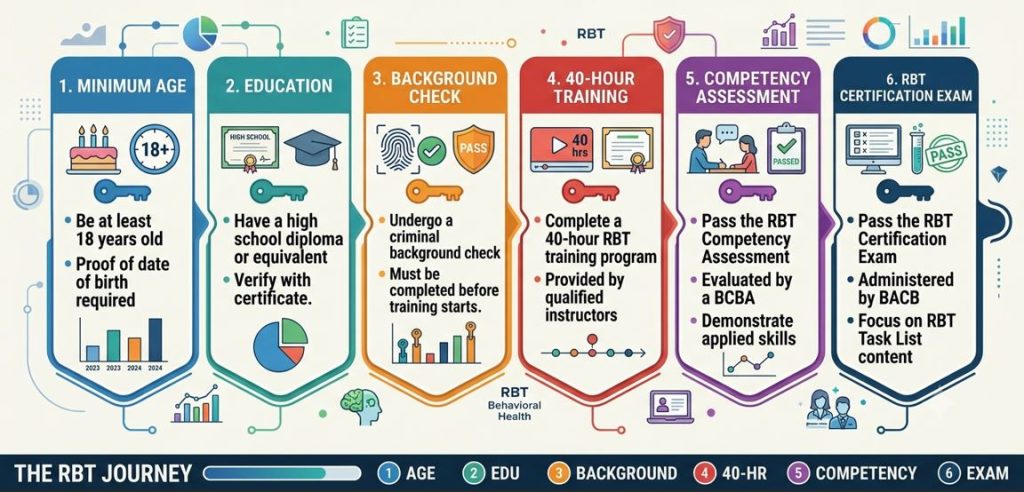
| Requirement | Detail |
|---|---|
| Age | 18 years or older |
| Education | High school diploma or equivalent |
| Training | 40-hour course based on BACB 2026 Curriculum Outline |
| Competency | Pass Initial Competency Assessment (in person) |
| Background check | Within 180 days before applying |
| Supervisor | Must be added as a supervisee by a qualified BCBA/BCaBA after passing |
Step-by-Step: How to Become an RBT in 2026
- Confirm eligibility (age, education, background).
- Complete the 40-hour RBT training through a BACB-approved provider.
- Pass the Initial Competency Assessment with a qualified BCBA/BCaBA.
- Complete a criminal background check within 180 days.
- Submit your BACB application with $65 fee.
- Receive Authorization to Test (ATT) by email.
- Schedule your exam through Pearson VUE and pay $45.
- Take the exam at an in-person Pearson VUE center.
- Get added as a supervisee by your BCBA/BCaBA (certification stays inactive until this step is complete).
- Begin practice under supervision and complete annual renewal each year.
The 4-Week RBT Study Plan (Proven Structure)
A 4-week RBT study plan should allocate study time proportional to domain weights: focus more on Behavior Acquisition (25%) and Behavior Reduction (19%), and less on Behavior Assessment (11%). Each week should combine concept review, targeted quizzes, and a timed mock exam.
Week 1: Foundation + Highest-Weight Domains
- Days 1–2: Read the BACB RBT Task List (3rd Edition) end to end. Take a diagnostic 25-question beginner practice test with no preparation to identify weak areas.
- Days 3–5: Deep study of Domain C — Behavior Acquisition (DTT, prompting, chaining, shaping, verbal operants). Take the Skill Acquisition unit quiz.
- Days 6–7: Deep study of Domain D — Behavior Reduction (extinction, DRA/DRI/DRO/DRL, NCR). Take the Behavior Reduction unit quiz.
Week 2: Data, Assessment, and Ethics
- Days 8–9: Domain A — Data Collection & Graphing. Practice calculating rate, percentage, and duration from sample datasets. Take the Data Collection quiz.
- Days 10–11: Domain B — Behavior Assessment. Focus on preference assessment types and your supporting role under the BCBA. Take the Behavior Assessment quiz.
- Days 12–14: Domain F — Ethics. Read the BACB Ethics Code for RBT Certificants 2.0 in full. Take the Ethics quiz.
Week 3: Documentation + First Full Mock
- Days 15–16: Domain E — Documentation & Reporting. Practice rewriting subjective notes as objective ones. Take the Documentation quiz.
- Day 17: Review all 6 domains with RBT flashcards.
- Day 18: Take the 75-question full mock exam — timed.
- Days 19–21: Review every incorrect answer in detail. Re-quiz weak domains.
Week 4: Simulation + Polish
- Days 22–24: Take the 80-question advanced mock. Identify any remaining weak areas. Spend 30–45 minutes daily on flashcards.
- Day 25: Take the 85-question full-length simulation under strict exam conditions (90 minutes, no notes, no phone).
- Days 26–27: Light review only. Focus on common traps (DRA vs. DRI, forward vs. backward chaining, extinction burst expectations).
- Day 28 (exam day): Rest. Arrive 30 minutes early. Bring valid government-issued ID matching your BACB account name exactly.
RBT Exam Day Checklist
On RBT exam day, arrive 30 minutes early at the Pearson VUE center, bring a valid government-issued photo ID matching your BACB account name exactly, and leave all personal items in the secure locker provided.
Bring:
- ✅ Government-issued photo ID (driver’s license, passport, or military ID)
- ✅ Confirmation email from Pearson VUE
- ✅ Knowledge of your BACB ID number
Do NOT bring (must be locked away):
- ❌ Phone, smartwatch, fitness tracker
- ❌ Notes, books, scratch paper
- ❌ Bags, jackets with pockets, hats (in most centers)
- ❌ Food or drink (some centers offer water only)
At the center:
- Arrive 30 minutes early.
- Present your ID; you’ll be photographed.
- Sign an NDA on the testing system.
- Read a brief tutorial of the Pearson VUE interface.
- Begin your 90-minute exam.
- Mark difficult questions and return to them at the end.
- Use any remaining time to review flagged questions.
Essential RBT Glossary (Top 40 Terms)
| Term | Definition |
|---|---|
| ABC Data | Antecedent–Behavior–Consequence recording used in functional assessment |
| Antecedent | Event/stimulus immediately before a behavior |
| Backward Chaining | Teaching the last step independently first; earlier steps prompted |
| BCBA | Board Certified Behavior Analyst (graduate-level supervisor of RBTs) |
| BCaBA | Board Certified Assistant Behavior Analyst (bachelor’s-level) |
| Chaining | Teaching a multi-step behavior by linking individual steps |
| Consequence | Event/stimulus immediately after a behavior |
| Continuous Measurement | Records every instance of a behavior |
| Differential Reinforcement | Reinforcing one response class while withholding for another |
| Discontinuous Measurement | Samples behavior (interval recording, time sampling) |
| Discrimination Training | Teaching response in presence of one stimulus, not another |
| DRA / DRI / DRO / DRL | Four types of differential reinforcement (see table above) |
| DTT | Discrete Trial Training — structured antecedent → response → consequence trials |
| Duration | Length of time a behavior occurs |
| Echoic | Verbal operant — repeating what’s heard |
| Errorless Learning | Teaching procedure that minimizes opportunities for incorrect responses |
| Extinction | Withholding reinforcement that previously maintained a behavior |
| Extinction Burst | Temporary increase in behavior when extinction begins |
| FBA | Functional Behavior Assessment |
| Forward Chaining | Teaching the first step independently first; later steps prompted |
| Frequency | Count of behavior occurrences |
| Generalization | Behavior occurs across new people, settings, or stimuli |
| Intraverbal | Verbal operant — verbal response to a verbal antecedent (conversation) |
| Latency | Time between an antecedent and the start of a behavior |
| Mand | Verbal operant — a request |
| MSWO | Multiple Stimulus Without Replacement preference assessment |
| NCR | Noncontingent reinforcement — delivered on a schedule, not contingent on behavior |
| NET | Naturalistic Environment Teaching |
| Operational Definition | Behavior described in observable, measurable terms |
| Permanent Product | Measuring the result of behavior (worksheets completed, items broken) |
| Prompt | Stimulus that helps evoke a correct response |
| Prompt Fading | Gradually reducing prompts to build independence |
| Rate | Frequency divided by time (count per minute) |
| Reinforcement | Consequence that increases future behavior |
| Shaping | Reinforcing successive approximations toward a target behavior |
| Stimulus Control | Behavior occurs reliably in presence of a specific stimulus |
| Tact | Verbal operant — labeling/naming what’s observed |
| Task Analysis | Breaking a complex skill into smaller steps |
| Token Economy | System where tokens earned can be exchanged for backup reinforcers |
| Total Task Chaining | Teaching every step in the chain each session |
RBT vs. BCaBA vs. BCBA: What’s the Difference?
An RBT is an entry-level behavior technician who implements ABA services under supervision. A BCaBA holds a bachelor’s degree and can supervise RBTs but works under a BCBA. A BCBA holds a master’s degree, is independently licensed to design and oversee behavior plans, and supervises RBTs and BCaBAs.
| Credential | Education | Role | Supervises |
|---|---|---|---|
| RBT | High school + 40-hr training | Implements behavior plans | No one |
| BCaBA | Bachelor’s degree + coursework + supervised experience + exam | Implements and assists with design under BCBA | RBTs |
| BCBA | Master’s degree + ABA coursework + supervised experience + exam | Designs, assesses, supervises | RBTs and BCaBAs |
Many BCBAs began as RBTs — the hands-on hours count toward future BCBA fieldwork.
7 Most Common Mistakes RBT Candidates Make (And How to Avoid Them)
- Studying passively. Re-reading the Task List PDF without practicing scenario questions is the #1 cause of failure. Switch to active recall and practice tests early.
- Skipping ethics. Ethics is now 15% of the exam and contains the trickiest questions. Read the BACB Ethics Code 2.0 in full at least twice.
- Confusing similar procedures. DRA vs. DRI, forward vs. backward chaining, partial-interval vs. whole-interval — these are exam favorites. Build a comparison sheet.
- Ignoring extinction burst. If the exam describes behavior briefly increasing after extinction begins, that’s expected, not a failure.
- Overstepping the RBT scope. If a question asks what the RBT should do about a new clinical concern, the answer is almost always consult the BCBA.
- Subjective documentation language. “Frustrated,” “upset,” “tired” — the exam will mark these wrong. Stick to observable, measurable descriptions.
- Cramming the night before. Sleep matters more than last-minute review. Schedule serious study at least 3 days before the exam, then rest.