What Does an RBT Do? Roles, Duties & Career Overview (2026 Guide)
A Registered Behavior Technician (RBT) is a certified paraprofessional who delivers applied behavior analysis (ABA) therapy under the supervision of a Board Certified Behavior Analyst (BCBA). RBTs work directly with clients, primarily children with autism spectrum disorder, to implement treatment plans, teach communication and daily living skills, collect behavioral data, and reinforce positive behaviors. The credential is issued by the Behavior Analyst Certification Board (BACB) and requires a 40-hour training program, a competency assessment, and a certification exam.
Key Takeaways
- An RBT delivers one-on-one ABA therapy sessions, carrying out treatment plans designed by a supervising BCBA.
- Core daily tasks include teaching communication and social skills, collecting behavioral data, running discrete trial training, and collaborating with families.
- RBTs work across clinics, schools, homes, hospitals, and community settings.
- Certification requires a high school diploma, 40 hours of training, a competency assessment, and passing an 85 question exam.
- Average RBT salary in 2026 ranges from $38,000 to $47,000 per year depending on state and experience.
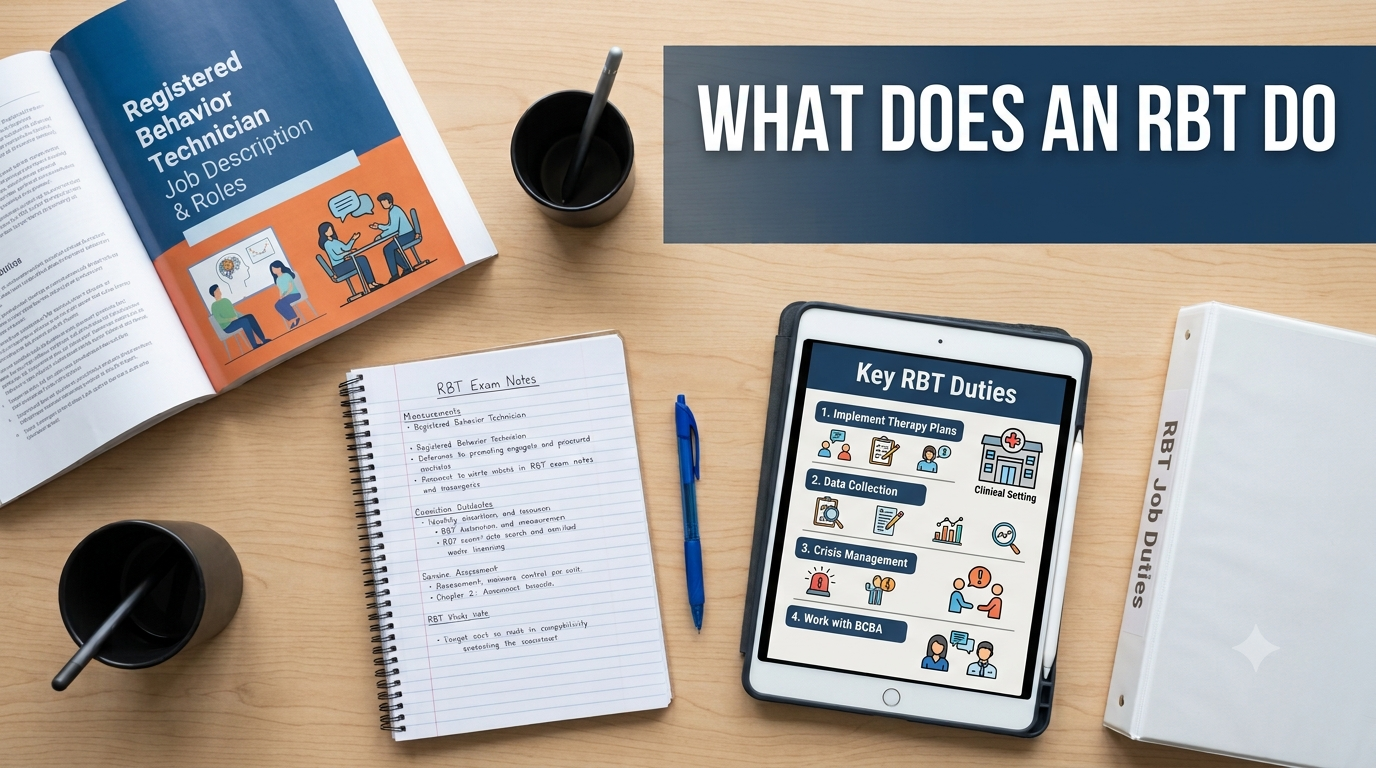
An RBT implements ABA therapy by working one-on-one with clients (usually children with autism) to teach new skills, reduce challenging behaviors, and collect progress data. They follow treatment plans created by a supervising BCBA and never work independently. Think of the BCBA as the architect and the RBT as the builder who brings the blueprint to life every single day.
What Does an RBT Do in Simple Terms?
A Registered Behavior Technician is the frontline therapist in ABA treatment. RBTs spend their sessions directly engaging with clients, teaching everything from basic communication to social interaction and self-care routines, all while carefully documenting progress.
In practice, the role feels less like a clinical position and more like guided mentorship. You build genuine relationships with your clients, learn what motivates them, and use that knowledge to help them grow. The BCBA designs the roadmap, but the RBT walks alongside the client every step of the way. Most people discover that the daily variety and personal connection make this one of the most rewarding entry-level healthcare positions. The BACB describes RBTs as paraprofessionals who deliver behavior analytic services under close, ongoing supervision, which ensures that every strategy used is backed by evidence and tailored to the individual.
What Does an RBT Do Daily?
RBTs follow a structured but dynamic routine centered on client sessions, data collection, and team communication. A typical day involves preparing session materials, conducting therapy, recording behavioral observations, and debriefing with a BCBA.
Each morning usually starts with reviewing current treatment goals and gathering materials. During sessions, the RBT runs skill acquisition programs using techniques like discrete trial training (DTT) or natural environment teaching (NET). Throughout every activity, the RBT tracks data in real time, recording correct responses, behavior duration, and whether skills are generalizing. After sessions, RBTs write objective notes, communicate updates to their BCBA, and often connect with parents about progress and challenges. What most articles miss is how much relationship building matters. When you actually work as an RBT, therapy only succeeds when the client trusts you and enjoys the interaction.
What Does an RBT Do in ABA Therapy?
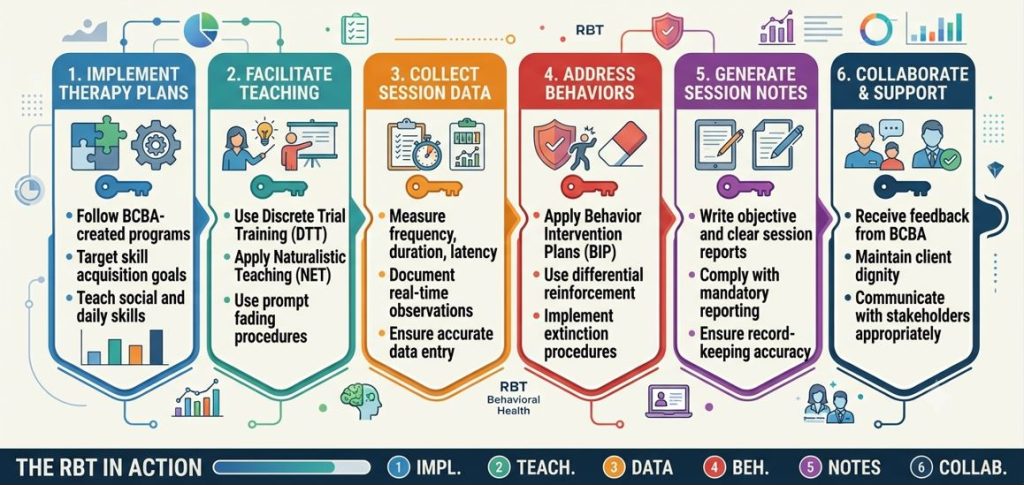
In ABA therapy, the RBT implements the behavior intervention plan and skill acquisition programs created by the supervising BCBA. This means running teaching procedures, delivering reinforcement, and applying behavior reduction strategies during every session.
ABA is rooted in the science of learning. The core framework examines what happens before a behavior (antecedent), the behavior itself, and what follows (consequence). RBTs apply this constantly. During discrete trial training, for example, the RBT presents a clear instruction, waits for the client’s response, then provides reinforcement or correction. Each teaching moment is a “trial,” and the RBT may run dozens in a single session. Beyond structured teaching, RBTs also use naturalistic strategies where learning happens within play and everyday routines, helping clients transfer skills to real-world situations.
What Does an RBT Do to Present the Antecedent of a Discrete Trial?
During a discrete trial, the RBT presents the antecedent by delivering a clear, concise instruction (called a discriminative stimulus) that signals the client to respond. This could be a verbal direction like “touch the red card,” holding up an object, or presenting a visual prompt.
The quality of the antecedent directly affects whether the trial produces useful data. RBTs learn to keep presentations brief, unambiguous, and consistent. After presenting the antecedent, the RBT waits a set time for the client to respond, delivers reinforcement for correct answers or an error correction for incorrect ones, and then records the outcome before a brief inter trial interval separates one trial from the next.
What Does an RBT Do in Schools?
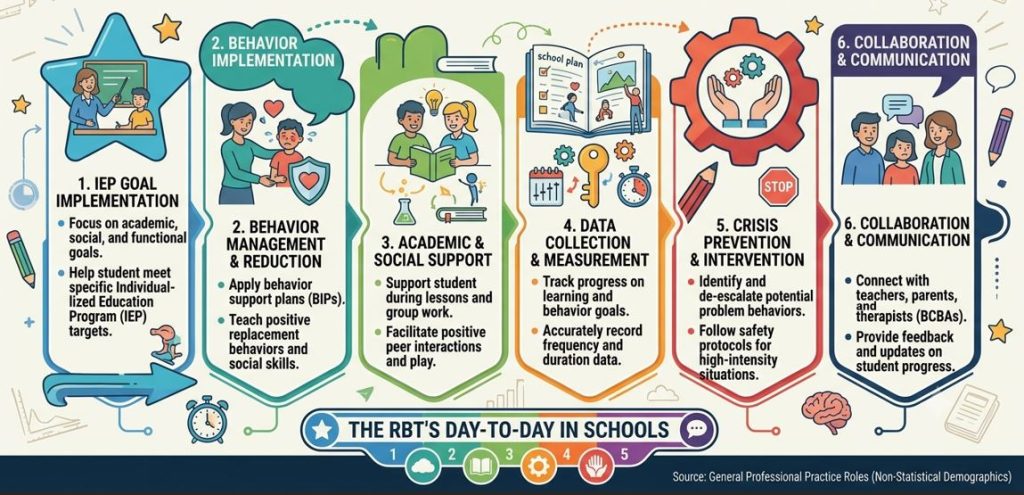
In school settings, RBTs support students by implementing behavior intervention plans, assisting with IEP goals, and helping students participate in classroom activities alongside peers.
School based RBTs collaborate with teachers, special education staff, and administrators to ensure ABA strategies complement the learning environment. They help students transition between activities, prompt social interactions during lunch, and provide one on one support during academic tasks. The emphasis is on inclusion: the goal is to give students enough behavioral support to stay in the classroom. The American Association of School Administrators has highlighted how RBTs allow schools to respond to behavioral challenges in real time without removing students from instruction, benefiting the entire classroom.
What Does an RBT Do During a Functional Assessment?
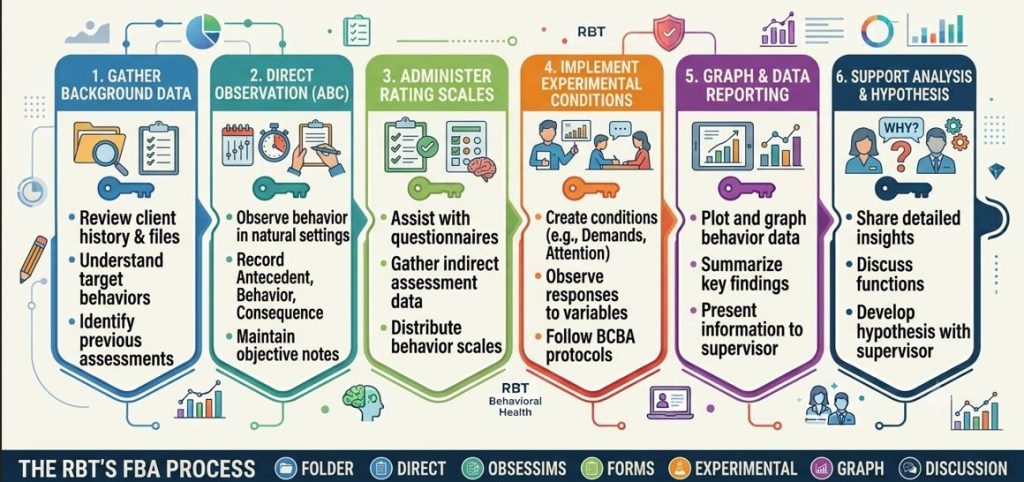
During a functional behavior assessment (FBA), the RBT assists the BCBA by collecting ABC data, observing behavior across settings, and implementing assessment conditions as directed. RBTs never design or interpret assessments independently.
The RBT’s contribution is critical because they typically spend more time with the client and often have stronger rapport, leading to more accurate data. The information collected helps identify the function behind a behavior, whether a client is seeking attention, escaping a task, pursuing sensory input, or wanting a preferred item. Understanding the “why” allows the BCBA to design interventions that create lasting change.
RBT vs BCBA: Key Differences
| Area | RBT | BCBA |
|---|---|---|
| Education | High school diploma | Master’s degree |
| Training | 40 hour program | Graduate coursework + supervised hours |
| Certification Exam | 85 questions, $45 fee | Board certification exam |
| Scope | Implements plans under supervision | Designs plans, conducts assessments, supervises |
| Independence | Requires ongoing supervision | Can practice independently |
| Salary (2026) | $38,000 to $47,000/year | $65,000 to $95,000/year |
Many BCBAs started as RBTs. The clinical experience gained at the RBT level counts toward the supervised fieldwork hours required for BCBA certification, making it a strategic stepping stone.
How to Become an RBT in 2026
Becoming an RBT requires meeting a few eligibility criteria and completing a structured certification process that can be finished in weeks. Candidates must be at least 18 years old with a high school diploma, complete an approved 40 hour training program aligned with the BACB RBT Task List 3rd Edition, pass a competency assessment, submit a BACB application ($50), and pass the Pearson VUE exam ($45). As of January 2026, the BACB shifted to biennial renewal cycles with Professional Development Unit (PDU) requirements.
For candidates preparing for the exam, practicing with scenario based questions aligned with the current task list using a comprehensive RBT practice exam is one of the most effective strategies.
RBT Salary and Job Outlook
As of 2026, national averages place the annual RBT salary between $38,000 and $47,000, based on data from Indeed and ZipRecruiter. Hourly rates typically range from $16 to $25. State matters significantly, with Hawaii leading at approximately $54,000 per year. Hospital and school district positions generally offer stronger benefits than private agency roles.
The Bureau of Labor Statistics projects over 25% job growth for behavioral health roles through 2032, making RBT one of the fastest growing credentials in healthcare. Exploring a detailed RBT study guide can help build the foundational knowledge needed for both the exam and clinical practice.
Conclusion
The RBT role sits at the heart of ABA therapy. As the person who spends the most direct time with clients, the RBT shapes daily progress in communication, behavior, and independence. Whether you are exploring this career, preparing for the RBT certification exam, or trying to understand the role as a parent or educator, the bottom line is clear: RBTs transform treatment plans into real life outcomes, one session at a time.
Start by reviewing free RBT practice questions to gauge your readiness and focus your preparation where it matters most.
What does an RBT do exactly?
A Registered Behavior Technician delivers one on one ABA therapy by implementing treatment plans designed by a BCBA. Daily tasks include teaching communication and social skills, running structured procedures like discrete trial training, collecting behavioral data, and updating the therapy team. RBTs do not create treatment plans or work without supervision.
Is RBT a good career choice?
RBT is a strong entry point into behavioral health. It requires minimal upfront investment (a high school diploma and roughly $95 in BACB fees), the credential is nationally recognized, and demand continues to grow. Many RBTs advance toward BCBA certification for significantly higher earning potential.
How long does it take to become an RBT?
The process can be completed in a few weeks. It involves a 40 hour training program, a competency assessment, and the certification exam. The timeline depends on how quickly you complete training and schedule your exam through Pearson VUE.
Can an RBT work without a BCBA?
No. RBTs must operate under close, ongoing supervision of a BCBA or BCaBA at all times. Working without supervision violates BACB ethical standards. The supervising analyst oversees all work the RBT performs and makes clinical decisions about the treatment plan.
What is the RBT exam pass rate?
Approximately 75% of first time candidates pass the RBT exam. For retakes, the rate drops to about 38%. Thorough preparation with scenario based practice questions, rather than passive studying, significantly improves first attempt success.
Do RBTs only work with children?
No. While most positions involve children with autism, RBTs also work with adolescents, adults, and elderly individuals who have developmental disabilities, brain injuries, or behavioral health conditions. ABA principles apply across the lifespan.
How much does an RBT make per hour?
Hourly wages typically range from $16 to $25 as of 2026, with the national average around $19 to $23. Geographic location, experience, employer type, and benefits packages all influence where a role falls within that range
What is the difference between an RBT and a behavior therapist?
An RBT holds a specific BACB credential verifying standardized training and exam passage. “Behavior therapist” is a broader, often unlicensed title. Most clinical settings prefer or require the RBT credential because it guarantees baseline competency and ethical accountability.
What does an RBT do in a hospital?
Hospital based RBTs provide behavioral support to patients with developmental disabilities, brain injuries, or conditions affecting behavior. They implement ABA interventions to improve compliance with medical procedures, reduce self injurious behaviors, and teach adaptive skills, collaborating closely with medical professionals.
Can an RBT become a BCBA?
Yes. Many BCBAs began as RBTs. Advancement requires earning a master’s degree in behavior analysis or a related field, completing supervised fieldwork hours, and passing the BCBA certification exam. RBT experience provides a strong clinical foundation for this path.
What does an RBT do in a clinic all day?
Clinic based RBTs typically run multiple one on one sessions lasting one to three hours each. Between sessions, they prepare materials, write session notes, review data with their BCBA, and collaborate with other team members. Clinic environments tend to be highly structured with dedicated therapy rooms and consistent schedules.
What are the 2026 RBT certification requirements?
Candidates must be at least 18, hold a high school diploma, complete a 40 hour training program aligned with the RBT Task List 3rd Edition, pass a competency assessment, submit a BACB application ($50), and pass the 85 question Pearson VUE exam ($45). Renewal is now biennial with PDU continuing education requirements.
What is the hardest part of being an RBT?
Many RBTs cite emotional resilience as the biggest challenge. Working with clients who exhibit aggressive or self injurious behaviors can be physically and emotionally demanding. Progress sometimes happens slowly, and maintaining motivation during difficult sessions, especially in the first year, requires patience and strong self care habits.