How to Become an RBT in 2026: Steps, Costs, Time and State Rules
- The BACB certifies RBTs nationally, so there is no separate state RBT license in Texas, Florida, California, Georgia, New Jersey, North Carolina, or Indiana. State Medicaid rules still decide whether an employer can bill for your work.
- North Carolina Medicaid now requires technicians to hold RBT or QABA’s ABAT certification, with a 120 day grace period that began August 1, 2026.
- The fastest realistic path takes about three to six weeks, because training alone must last at least 5 days and application processing takes about two weeks.
- Since January 1, 2026, the exam follows the RBT Test Content Outline (3rd ed.), and new RBTs recertify every two years with 12 professional development units.
- The first time RBT exam pass rate was 75% in 2025, according to BACB data.
Quick Answer
To become an RBT (Registered Behavior Technician), you must be at least 18, hold a high school diploma or equivalent, pass criminal background and abuse registry checks, finish a 40 hour training that meets the Behavior Analyst Certification Board’s (BACB) 2026 requirements, and pass an Initial Competency Assessment with a qualified assessor. You then apply through your BACB portal account for $65, schedule the RBT exam with Pearson VUE for $45, and pass it. Your certification becomes active only once a qualified BCBA or BCaBA adds you as their supervisee.
What Is an RBT?
An RBT is a paraprofessional certified in behavior analysis who delivers applied behavior analysis (ABA) services under close supervision. The BACB, a nonprofit founded in 1998 and based in Littleton, Colorado, grants the credential.
In practice, RBTs carry out treatment plans that a BCBA or BCaBA designs. That usually means running discrete trial teaching, collecting session data, supporting preference assessments, and writing objective session notes, often with autistic children in homes, clinics, and schools. You never design or change a treatment plan yourself. For a fuller picture of the daily work, read what an RBT actually does on the job.
RBT Requirements at a Glance
Every applicant must meet the same six BACB eligibility requirements before applying, no matter which state they live in.
| Requirement | What the BACB expects | Timing rule |
|---|---|---|
| Age | 18 or older | At application |
| Education | High school diploma or equivalent | At application |
| Criminal background check | Passed, comparable to checks for teachers or child care workers | Within 180 days before paying for the application |
| Abuse registry check | Passed, or marked unavailable where no registry exists | Within 180 days before paying |
| 40 hour training | Meets the RBT 2026 40 Hour Training Requirements | Finished in no fewer than 5 and no more than 180 days |
| Initial Competency Assessment | Completed with a qualified assessor | After training, within 90 days before applying |
An Attesting Certificant also signs an attestation form confirming your age, education, and checks. That person cannot be related to you, subordinate to you, or employed by you.
How to Become an RBT: Step by Step
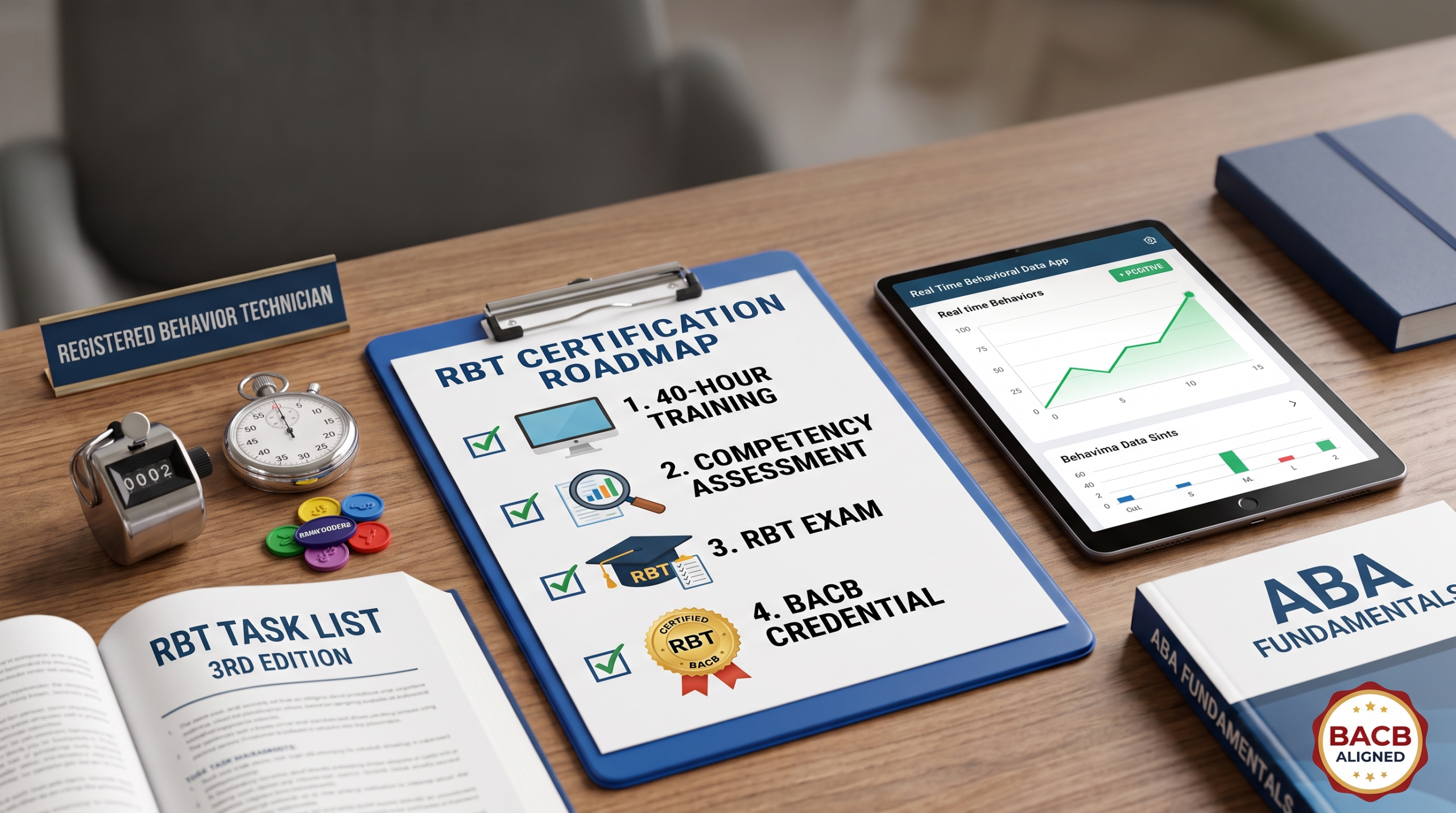
The process moves in a fixed order: portal account, training, competency assessment, application, exam, supervisor. Skipping ahead only wastes fees.
Step 1: Create your BACB portal account
Use your full legal name exactly as it appears on your government ID, plus a personal email address. A name mismatch will stop you from testing later, and a work email can leave you locked out if you change jobs.
Step 2: Complete the 40 hour training
The 2026 training must be overseen by a Responsible Trainer who holds BCaBA or BCBA certification and has completed the 8 hour supervision training. It includes 5 hours on ethics and professionalism and uses behavioral skills training, meaning instruction, modeling, role play, and feedback.
Step 3: Pass the Initial Competency Assessment
A qualified assessor watches you perform core tasks, some with a real client and some through role play. What most articles miss is the timing: the assessment must happen within 90 days before you submit your application, so a long gap after training can force a repeat.
Step 4: Apply and pay $65
Upload your attestation form, training certificate, and completed assessment, then pay the application fee. The BACB asks you to allow about two weeks for processing, and an application stays open for 90 days.
Step 5: Schedule and pass the RBT exam
After approval, you have one year to test. The exam runs 90 minutes, contains 85 multiple choice questions (75 scored), and is delivered only in person at Pearson VUE centers. Study with the RBT Task List (3rd edition) breakdown so you know exactly which 43 tasks are tested.
Step 6: Get added by your supervisor
Your certification starts as inactive. It turns active only when your RBT Supervisor or RBT Requirements Coordinator adds you as a supervisee in their BACB account.
Can You Become an RBT Online?
You can complete most of the path online, but not all of it. The 40 hour training can be delivered online, and the application happens in your BACB portal. However, the competency assessment requires observation by a qualified assessor, and the exam is taken only in person.
Many online courses are self paced, which suits people working full time. Still, check two things before paying: that the course states it meets the 2026 BACB requirements, and that it gives you a certificate signed by a qualified Responsible Trainer. The BACB does not provide training or recommend specific programs, so this due diligence is on you.
How Long Does It Take to Become an RBT?
Most people become an RBT in about one to three months, and a focused candidate can finish in roughly three to six weeks. The BACB’s own rules set the floor, not your study speed.
Here is where the time actually goes:
| Stage | Realistic time |
|---|---|
| 40 hour training | 5 days minimum, often 2 to 4 weeks part time |
| Finding an assessor and finishing the competency assessment | 1 to 3 weeks |
| BACB application processing | About 2 weeks |
| Exam scheduling and study | 1 to 3 weeks |
These ranges are estimates built around the BACB’s fixed minimums. Most people discover the slowest step is lining up a qualified assessor, which is why applicants who already work at an ABA company usually finish fastest.
How Hard Is It to Become an RBT?
Becoming an RBT is moderately challenging, mainly because of the exam. BACB data shows 75% of first time candidates passed in 2025, while only 38% of retake candidates did.
That retake gap tells you something important. The exam uses applied scenarios, so candidates who only memorize definitions tend to struggle, and the problem often repeats on later attempts. The better approach is to pair a complete RBT study guide with timed scenario questions, then review every missed item. You get up to 8 attempts within 12 months of approval, with 7 days between attempts, and each retake appointment costs $45.
How Much Does It Cost to Become an RBT?
BACB and Pearson VUE fees total $110 for a first attempt. Your training and background checks add to that, and their prices vary by provider and state.
| Cost item | Amount |
|---|---|
| BACB certification application | $65 |
| Pearson VUE exam appointment | $45 |
| Each retake appointment | $45 |
| Two year recertification fee | $50 |
| 40 hour training and background checks | Varies; many employers cover them |
Veterans eligible for the GI Bill can get BACB exam fees reimbursed through the Department of Veterans Affairs, pass or fail.
How to Become an RBT Therapist
“RBT therapist” is a popular search term, but RBTs are technicians, not independent therapists. You follow the same certification steps above, then work under a BCBA or BCaBA who remains responsible for the treatment.
The title matters more than it seems. Texas Medicaid, for example, bars behavior technicians from calling themselves “therapist” when working with Medicaid families. If you want an independent clinical role, the RBT credential is a strong first step toward BCaBA or BCBA certification, which require graduate coursework and supervised fieldwork.
How to Become an RBT in Texas
Texas has no state RBT license; you follow the standard BACB process. Texas licenses behavior analysts through the Texas Department of Licensing and Regulation, but Texas Occupations Code Section 506.054 exempts technicians working under a licensed behavior analyst’s direction.
That exemption applies when your job title is one the statute names, such as “behavior technician” or “tutor.” Texas Medicaid also covers ABA for eligible children through TMHP, and employers serving Medicaid clients commonly expect RBT certification. Confirm your employer’s payer requirements before you start training.
How to Become an RBT in Florida
Florida residents follow the BACB process, and Florida Medicaid lists RBTs as recognized behavior analysis providers. The Agency for Health Care Administration’s coverage policy allows services from RBTs credentialed by the BACB working under a BCBA or BCaBA.
What this means for you: if you want to work with Medicaid clients in Florida, BACB certification is effectively the entry ticket. Many Florida employers also run their own background screening, so expect a separate check during hiring even if you already passed one for your application.
How to Become an RBT in California
California does not require a state RBT license, and its insurance law even allows uncertified paraprofessionals. Health and Safety Code Section 1374.73 defines a qualified autism service paraprofessional as an unlicensed and uncertified individual who meets set criteria and works under a qualified provider.
Here is the trade off. Legally, some California employers can hire you without RBT certification. In practice, many ABA agencies still prefer or require the RBT credential because it standardizes training and supervision, and it gives you more job options if you move out of state.
How to Become an RBT in Georgia
Georgia follows the national BACB process, and Georgia Medicaid policy requires RBT certification for technicians. Georgia licenses behavior analysts through the Georgia Behavior Analyst Licensing Board under Title 43, Chapter 7A of the state code.
A Georgia Medicaid ABA policy used by CareSource states that BACB certified RBTs may deliver ABA under an independent practitioner’s supervision if enrolled in the Medicaid program. As a result, Medicaid focused employers in Georgia will generally ask for your certification number before you see clients.
How to Become an RBT in NJ
New Jersey requires licensure for behavior analysts but not for RBTs. State licensure rules for applied behavior analysis took effect May 6, 2024, under the Board of Applied Behavior Analyst Examiners.
Under those rules, certified RBTs and other unlicensed staff can keep providing services under the supervision of a Licensed Behavior Analyst or Licensed Assistant Behavior Analyst. For you, that means earning RBT certification through the BACB and making sure your supervisor holds a valid New Jersey license.
How to Become an RBT in NC
North Carolina now requires certification for Medicaid funded behavior technicians. NC Medicaid accepts either BACB’s RBT or the ABAT credential from the Qualified Applied Behavior Analysis Credentialing Board (QABA) for research based behavioral health treatment.
Existing uncertified technicians received a 120 day grace period starting August 1, 2026, and new hires must certify within 120 days of hire. After that window, claims for services from uncertified technicians will not be reimbursed. State law, meanwhile, exempts technicians working under a licensed behavior analyst from needing their own license.
How to Become an RBT in Indiana
Indiana follows the BACB process, but its Medicaid rules changed on April 1, 2026. Before that date, only RBTs could render ABA therapy under Indiana Medicaid; the program now also allows BCaBAs, BCBAs, and health service providers in psychology to deliver services.
Indiana also began licensing behavior analysts through its Professional Licensing Agency in 2025. For new technicians, RBT certification remains the standard route into Indiana ABA jobs, though Medicaid coverage changes, including an age limit under 21, may affect which employers are hiring.
What Happens After You Become an RBT?
After certification, you must receive supervision for at least 5% of your service hours every month. That includes two face to face contacts, with at least one observation of you working with a client.
If you certify in 2026, you move to a two year recertification cycle and must earn 12 professional development units per cycle. You also follow the RBT Ethics Code (2.0), which contains 29 standards. Before exam day, a timed full length RBT mock exam is the best way to test whether you are ready.
Frequently Asked Questions
Do you need a college degree to become an RBT?
No. The BACB requires only a high school diploma or equivalent, along with the training, competency assessment, background checks, and exam.
Can you become an RBT at 17?
No. You must be at least 18 years old when you submit your RBT certification application.
Is the RBT exam online?
No. The RBT exam is delivered in person at authorized Pearson VUE testing centers and qualifying US military bases, not through remote proctoring.
How long is RBT certification valid?
RBTs who certify or recertify in 2026 move to a two year recertification cycle. Each cycle requires 12 professional development units, ongoing supervision, and a $50 recertification fee.
Does an employer have to pay for my RBT training?
No rule requires it, but many ABA employers pay for the 40 hour training and competency assessment for new hires.
Can I get RBT certified without a job?
Yes, but it is harder. You still need a qualified assessor for the competency assessment, and your certification stays inactive until a supervisor adds you.
Who can do my Initial Competency Assessment?
A qualified BACB certificant serving as your Responsible Assessor. The assessor cannot be related to you, subordinate to you, or employed by you.
What happens if I fail the RBT exam?
You can retake it up to 8 times within 12 months of your application approval, waiting 7 days between attempts and paying $45 for each appointment.
Can I transfer my RBT to another state?
Yes. RBT certification is national, so it moves with you within BACB jurisdiction, though your new employer and payers may add their own requirements.
Is QABA’s ABAT the same as an RBT?
No. ABAT is a separate technician credential from QABA. Some payers, including NC Medicaid, accept either one.
Can I work as a behavior technician before I am certified?
Sometimes. Some states and payers allow uncertified technicians under supervision, but others, like NC Medicaid after its grace period, will not reimburse their services.
Is becoming an RBT worth it?
For many people, yes. The BACB reported 246,109 certified RBTs at the end of 2025, and the credential is a common first step toward BCaBA or BCBA certification.
Does my 40 hour training from before 2026 still count?
Only if it meets all current 2026 requirements. Check with your training provider before submitting an older certificate.
Conclusion
Becoming an RBT is a clear, affordable process once you follow the steps in order: meet eligibility, train, prove your skills, apply, pass the exam, and connect with a supervisor. Your state mainly shapes what employers and Medicaid expect, not the certification itself. If you are already studying, see why people fail the RBT exam so you avoid the most common mistakes.
For official details, review the BACB’s RBT Handbook, the RBT 2026 40 Hour Training Requirements, and NC Medicaid’s certification update if you plan to work in North Carolina. Then pick a start date for your training and take the first step this week.