Why People Fail the RBT Exam: 7 Mistakes That Cost You Your Certification
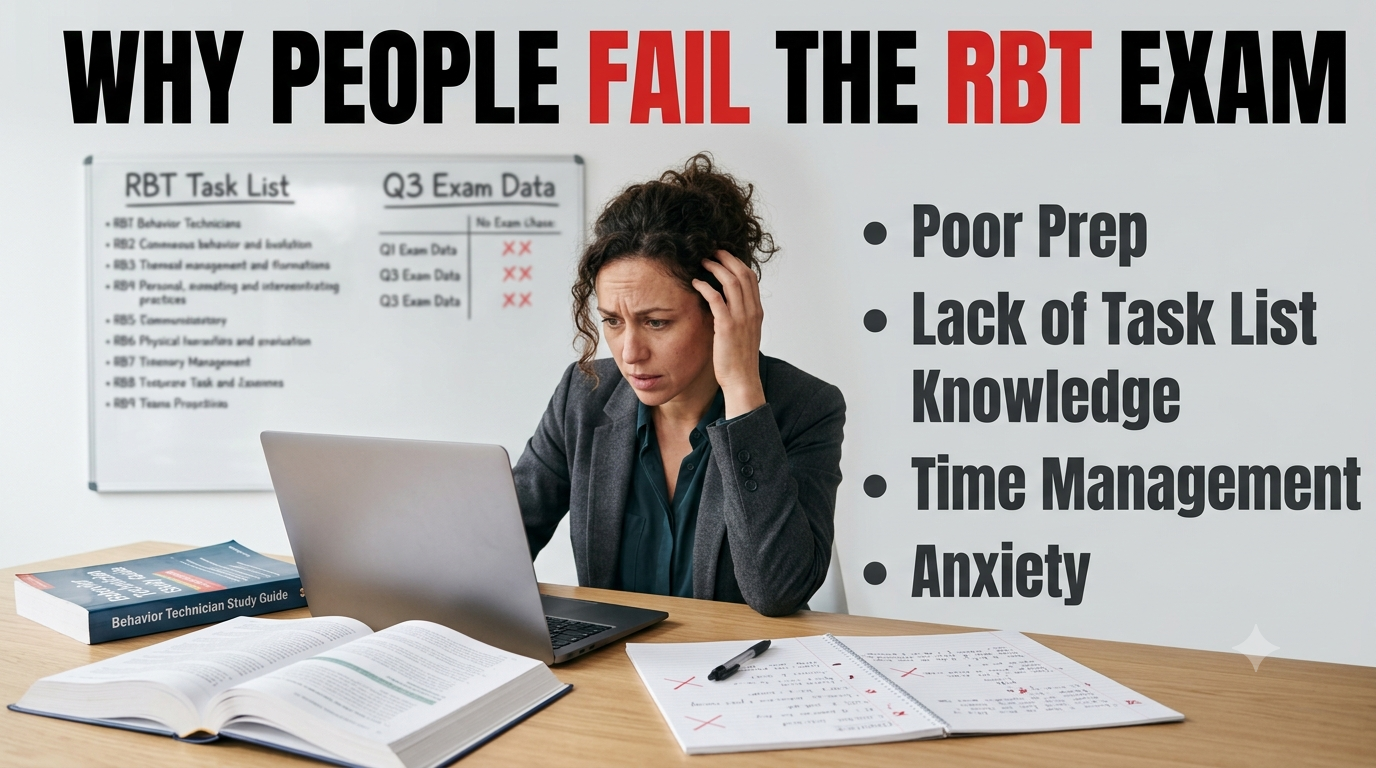
Most people fail the RBT exam not because the content is too difficult, but because they prepare the wrong way. According to BACB data, approximately 75% of first time candidates pass, meaning 1 in 4 fail on their initial attempt. The retake pass rate drops to around 38%. The most common reasons include passive studying, underestimating scenario based questions, neglecting high weight domains, and poor time management during the 90 minute test.
Key Takeaways
- About 25% of first time RBT exam candidates fail, and the retake pass rate drops to roughly 38%.
- The exam tests applied knowledge through clinical scenarios, not memorized definitions.
- Skill Acquisition carries the highest weight at roughly 25% of scored items.
- Ethics questions are consistently rated the most difficult because multiple answers seem correct.
- Low quality training programs report pass rates as low as 61%, while top programs exceed 87%.
- Timed practice exams are one of the strongest predictors of first attempt success.
People fail the RBT exam because they memorize definitions instead of practicing applied, scenario based questions. The exam tests clinical decision making, not recall. Underpreparing for Skill Acquisition, underestimating ethics, choosing a weak training program, and skipping timed mock exams are the biggest pitfalls.
Why Is the RBT Exam So Hard to Pass?
The RBT exam is not a vocabulary test. It is an application based assessment where nearly every question presents a clinical scenario and asks you to choose the best response from four options that may all seem partially correct.
This catches most candidates off guard. During a 40 hour training, the focus is on learning ABA principles conceptually. The Pearson VUE exam flips the script. Instead of asking “What is positive reinforcement?”, it describes a situation and asks what the RBT should do next. That gap between knowing the concept and applying it under pressure is where failure happens. The exam has 85 questions (75 scored, 10 unscored) and gives you 90 minutes, roughly 63 seconds per question. Candidates who linger on early items often run out of time before the final section.
The 7 Most Common Reasons People Fail
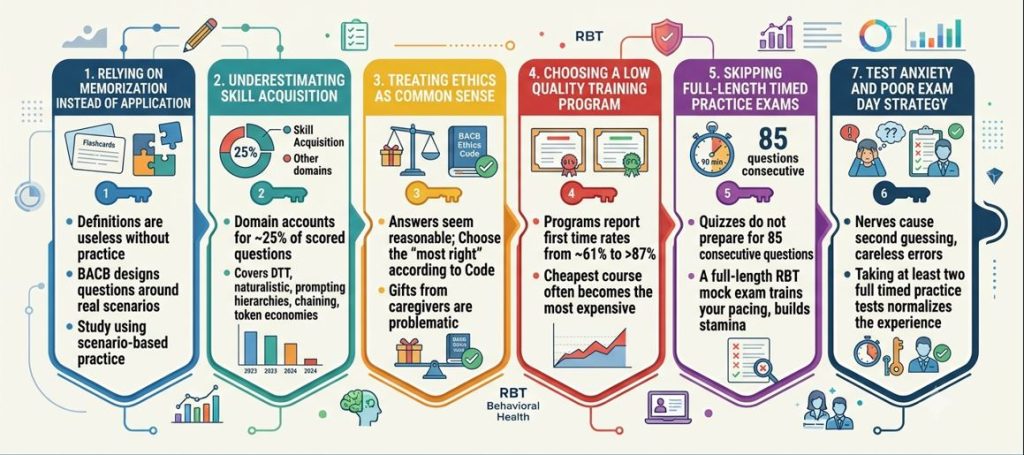
1. Relying on Memorization Instead of Application
The biggest reason candidates fail is studying definitions without practicing how to apply them. The BACB designs questions around real world scenarios. Knowing that an extinction burst means a temporary increase in behavior is useless if you cannot recognize it inside a clinical vignette.
Study using scenario based RBT practice exam questions that mirror the actual format. Every question should force you to think “what would I do here?”
2. Underestimating Skill Acquisition
Skill Acquisition (Behavior Acquisition under the 3rd Edition Task List) accounts for roughly 25% of scored questions. Despite this, many candidates spread study time evenly across all six domains. This domain covers DTT, naturalistic teaching, prompting hierarchies, chaining, shaping, token economies, and generalization. Most people discover that this is where they lose the most points because they did not allocate study time proportionally.
3. Treating Ethics as Common Sense
Ethics questions almost always have two or three answers that seem reasonable. You are choosing the “most right” answer according to the BACB Ethics Code, not your gut instinct. A caregiver offering a small gift after a session feels harmless. The Ethics Code disagrees. Focused study using an RBT ethics quiz trains you to think within the BACB framework.
4. Choosing a Low Quality Training Program
The BACB publishes pass rate data by training provider, and differences are dramatic. Some programs report first time rates as low as 61%, while top programs consistently exceed 87%. What most articles miss is that the cheapest course often becomes the most expensive: a failed attempt costs a $45 retake fee, more study weeks, and potentially a new competency assessment if your 90 day window expires.
5. Skipping Full Length Timed Practice Exams
Untimed quizzes teach concepts but do not prepare you for 85 consecutive questions under a 90 minute clock. A full length RBT mock exam trains your pacing, builds stamina, and reveals whether you truly know the material or just recognize it. Research in applied learning shows retrieval practice under test conditions outperforms passive review.
6. Ignoring the Score Report After Failing
The BACB provides a domain level score report after every attempt. This tells you exactly where your score dropped. Yet many candidates repeat the same study approach without using this data. If your report shows weakness in Behavior Reduction, spending weeks on Measurement will not help. Use focused domain quizzes to target your weakest areas.
7. Test Anxiety and Poor Exam Day Strategy
The in person Pearson VUE environment feels unfamiliar and high pressure. Nerves cause second guessing, slow pacing, and careless errors on questions you actually know. Taking at least two full timed practice tests normalizes the experience. On exam day, answer easier questions first, flag uncertain items, and maintain steady pacing.
RBT Exam Domain Weights: Where Points Are Lost
| Domain | Weight | Scored Questions |
|---|---|---|
| Behavior Acquisition | ~25% | ~19 questions |
| Behavior Reduction | ~19% | ~14 questions |
| Ethics | ~15% | ~11 questions |
| Data Collection and Graphing | ~13% | ~10 questions |
| Assessment | ~11% | ~8 questions |
| Documentation and Reporting | ~11% | ~8 questions |
Behavior Acquisition and Behavior Reduction together account for nearly half the scored exam. Candidates who give these domains proportionally more study time consistently outperform those who treat every domain equally.
What Happens If You Fail?
Failing does not end your certification journey. The BACB allows up to 8 retake attempts within 12 months, with a 7 day waiting period between attempts. Each retake costs $45 through Pearson VUE. The critical constraint is your competency assessment window: it is valid for 90 days, and if it expires before you pass, you need a new assessment. Preparing thoroughly for your first attempt saves real time and money.
How to Pass the RBT Exam on Your First Try
Candidates who pass on the first attempt share common habits: they use the BACB Task List as their study blueprint, practice with scenario based questions, take at least two full timed exams, and allocate study time by domain weight.
Start with a diagnostic practice test to find weak areas, then work through a comprehensive RBT study guide domain by domain. After each study session, take the corresponding domain quiz immediately. In the final week, complete a full 85 question simulation under timed conditions. Score above 80% and you are likely ready. Below that, use domain scores to focus remaining study days.
The Behavior Analyst Certification Board publishes official pass rate data and certification requirements at bacb.com. For additional context on ABA techniques tested in the Skill Acquisition domain, Autism Speaks provides accessible overviews of methods like discrete trial training.
Conclusion
Failing the RBT exam is frustrating but preventable. The exam confirms that you can apply ABA principles the way a working RBT uses them every day. Candidates who fail typically studied passively, skimmed high weight domains, or never sat through a full timed simulation.
Take a free RBT practice exam today, identify where you stand, and build a study plan that matches how the real exam actually tests you.
Why do so many people fail the RBT exam?
Most candidates fail because they memorize definitions instead of practicing applied scenario questions. The exam presents clinical situations requiring you to choose the best response, which demands different preparation than passive reading. Underestimating high weight domains and poor time management also contribute.
What is the RBT exam pass rate?
BACB data shows approximately 75% to 80% of first time candidates pass. Retake pass rates drop to roughly 38% to 46%, underscoring the importance of strong preparation before the first attempt.
How many times can you fail the RBT exam?
The BACB allows up to 8 attempts within a 12 month authorization period with a 7 day waiting period between attempts. Each retake costs $45 through Pearson VUE. If all attempts are exhausted, the candidate must reapply.
What is the hardest part of the RBT exam?
Ethics and Skill Acquisition are consistently rated the most difficult. Ethics questions require nuanced judgment based on the BACB Ethics Code. Skill Acquisition carries the most questions and tests applied clinical knowledge.
What score do you need to pass the RBT exam?
The BACB uses scaled scoring and does not publish an exact cut score. Most preparation experts recommend aiming for at least 80% correct on practice exams for a strong margin of safety.
Does the 40 hour training quality affect exam results?
Yes, significantly. BACB pass rate data shows some programs at 61% and top programs above 87%. The training course you choose directly impacts your readiness.
What happens if my competency assessment expires?
The Initial Competency Assessment is valid for 90 days. If you do not pass within that window, you must complete a new assessment with a qualified BCBA or BCaBA before continuing.
Should I study all domains equally?
No. The exam is weighted unevenly. Behavior Acquisition accounts for roughly 25% of scored questions while Assessment and Documentation each account for about 11%. Allocate study time proportionally.
How long should I study for the RBT exam?
Most candidates prepare for 2 to 6 weeks. Those with clinical ABA experience typically need 2 to 3 weeks of focused practice. Candidates new to ABA benefit from 4 to 6 weeks of structured study.
Is the RBT exam all multiple choice?
Yes. It consists of 85 multiple choice questions with four answer options each. 75 are scored and 10 are unscored pilot items. You cannot tell which are which, so treat every question as scored.
Can test anxiety cause you to fail?
Absolutely. The in person Pearson VUE environment is unfamiliar to many candidates, and anxiety leads to second guessing and slow pacing. Full length timed practice exams are the best way to reduce test anxiety.
What is the best way to prepare for the RBT exam?
Combine three elements: study domain by domain using the BACB Task List, practice with scenario based questions mirroring the real format, and complete at least two full length timed mock exams. Reviewing incorrect answers in detail after each session is equally important.
Can I take the RBT exam online?
No. As of September 2023, the BACB discontinued remote proctoring. The RBT exam is only available at in person Pearson VUE testing centers. There is currently no online testing option.